In today’s fast-moving digital world, abbreviations and slang dominate conversations across social media, texting, and online platforms.
One such commonly used abbreviation is “FM”. If you’ve seen it in a message and wondered what it means, you’re not alone.
This guide explains the meaning of “FM” in text, how it’s used, different contexts, examples, and everything you need to understand it clearly.
Whether you’re chatting on WhatsApp, scrolling through Instagram, or texting a friend, this article will give you a complete understanding.
What Does “FM” Mean in Text?
“FM” in text most commonly means:
“For Me”
It’s used when someone is expressing a personal opinion, preference, or choice.
Example:
- “That movie wasn’t that great FM.”
- “This is the best option FM.”
In these examples, “FM” simply adds a personal touch, meaning “in my opinion” or “according to me.”
Other Meanings of “FM” in Text
Although “For Me” is the most popular meaning, “FM” can have different interpretations depending on context.
Here are the most common ones:
| Abbreviation | Meaning | Context |
|---|---|---|
| FM | For Me | Personal opinions |
| FM | Frequency Modulation | Radio/technology |
| FM | Female | Gender reference |
| FM | Follow Me | Social media/gaming |
| FM | F*** Me | Slang (informal/emotional) |
Understanding context is key when interpreting “FM” correctly.
How “FM” Is Used in Everyday Conversations
People use “FM” in casual chats, social media comments, and even gaming chats. It’s especially popular among younger audiences who prefer short and quick messages.
Common ways people use “FM”:
- Sharing opinions
- Expressing preferences
- Giving feedback
- Reacting to something
Examples:
- “This song is boring FM.”
- “Pizza is better than burgers FM.”
- “That was a bad decision FM.”
Why People Use “FM” Instead of Full Phrases
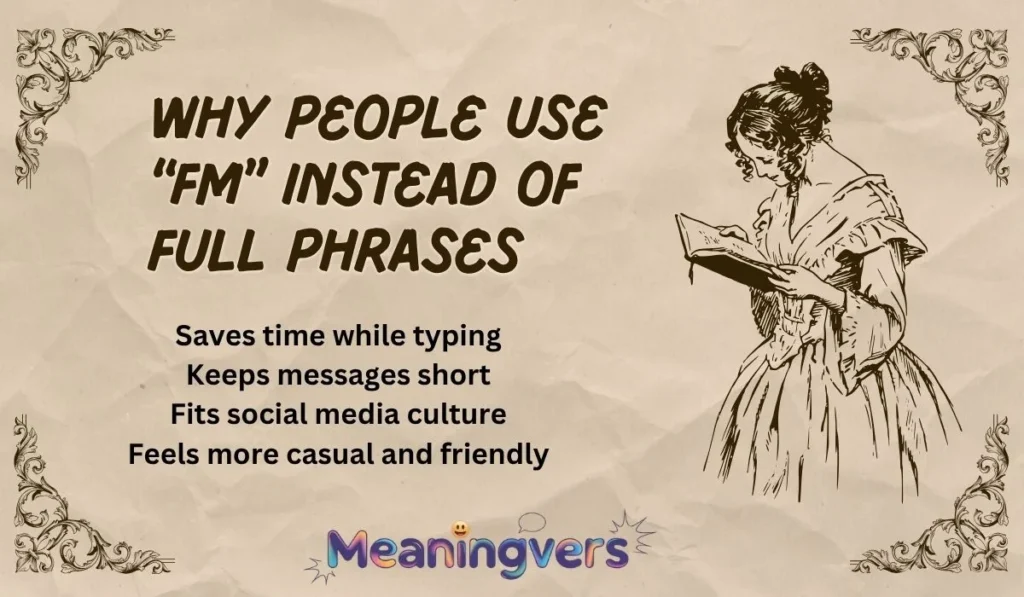
Short forms like “FM” are widely used because they make communication faster and easier.
Main reasons:
- Saves time while typing
- Keeps messages short
- Fits social media culture
- Feels more casual and friendly
In fast conversations, especially on apps like WhatsApp or Snapchat, users prefer abbreviations over full sentences.
“FM” in Social Media
On platforms like Instagram, TikTok, and Twitter, “FM” is often used in captions, comments, and replies.
Examples:
- “This trend is overrated FM”
- “Best outfit FM 🔥”
- “Not worth the hype FM”
Here, it adds a personal opinion without making the sentence longer.
“FM” in Gaming and Online Communities
Gamers also use “FM” frequently in chats during gameplay.
Possible meanings in gaming:
- Follow Me
- For Me
- Emotional slang
Example:
- “Stick together FM” (Follow Me)
- “This weapon is best FM”
Gamers often rely on short commands, making abbreviations like “FM” very useful.
“FM” vs Similar Text Slang
Understanding similar abbreviations helps avoid confusion.
| Slang | Meaning | Difference from FM |
|---|---|---|
| IMO | In My Opinion | More formal than FM |
| IMHO | In My Humble Opinion | Slightly polite tone |
| TBH | To Be Honest | Expresses honesty |
| FYI | For Your Information | Informational, not opinion |
“FM” is more casual and less formal compared to these.
When NOT to Use “FM”
Although “FM” is useful, it’s not suitable in all situations.
Avoid using it in:
- Professional emails
- Academic writing
- Formal conversations
- Business communication
Instead, use full phrases like:
- “In my opinion”
- “From my perspective”
Tone and Context Matter
“FM” can sometimes change meaning depending on tone and situation.
Example:
- “This is bad FM” → simple opinion
- “FM 😩” → emotional reaction
- “Come FM” → could mean “Follow Me”
Always read the full sentence to understand its intent.
Is “FM” Formal or Informal?
“FM” is considered informal slang.
It’s best suited for:
- Friends and family
- Social media
- Casual chats
Not suitable for:
- Workplace communication
- Professional settings
How to Respond When Someone Uses “FM”
When someone uses “FM,” they’re sharing their opinion.
You can respond by:
- Agreeing: “Yeah, same FM”
- Disagreeing: “Not really FM, I think it’s good”
- Asking: “Why FM?”
It opens the door for discussion.
Popular Situations Where “FM” Appears
You’ll often see “FM” in these situations:
- Movie reviews
- Music opinions
- Food preferences
- Fashion discussions
- Online debates
Example:
- “This phone is overpriced FM”
- “Best series ever FM”
Common Misunderstandings About “FM”
Some people confuse “FM” with technical or unrelated meanings.
Common confusion:
- Thinking it always means radio (Frequency Modulation)
- Misinterpreting it as a command
That’s why context is very important.
Evolution of Text Slang Like “FM”
Text slang has evolved rapidly with the rise of smartphones and social media.
“FM” is part of a larger trend where people:
- Shorten phrases
- Use acronyms
- Prefer quick communication
This trend continues to grow with platforms like TikTok and Instagram.
Tips to Use “FM” Correctly
To use “FM” effectively, keep these tips in mind:
- Use it only in casual conversations
- Make sure context is clear
- Avoid overusing it
- Combine with simple sentences
Good Example:
- “This game is fun FM”
Bad Example:
- “Regarding your proposal FM” (too informal)
Is “FM” Still Trending?
Yes, “FM” is still widely used, especially among younger users.
However, newer slang keeps emerging, so its popularity may shift over time.
Still, it remains relevant in everyday texting.
SEO Insight: Why People Search “FM Meaning in Text”
People often search this keyword because:
- They saw it in a message
- They want quick understanding
- They’re unfamiliar with slang
This makes it a high-intent keyword with strong search demand.
Quick Summary
- “FM” mainly means “For Me”
- It expresses personal opinions
- It’s informal and used in casual chats
- Context determines its exact meaning
- Not suitable for professional use
Frequently Asked Questions (FAQs)
What does FM mean in texting?
It usually means “For Me,” expressing a personal opinion.
Is FM slang?
Yes, it’s informal internet slang.
Can FM mean something else?
Yes, like “Follow Me” or “Frequency Modulation,” depending on context.
Is FM used on social media?
Yes, it’s commonly used in comments, captions, and chats.
Should I use FM in professional messages?
No, it’s too informal for professional communication.
Does FM mean the same everywhere?
Mostly yes, but context can slightly change its meaning.
Conclusion
Understanding what “FM” means in text helps you communicate more effectively in today’s digital world.
While it mainly stands for “For Me,” its meaning can vary depending on context, tone, and platform. Using it correctly makes your conversations sound natural and modern, especially in casual settings.
As online communication continues to evolve, abbreviations like “FM” will remain an essential part of digital language.
The key is knowing when and where to use them. Keep it simple, stay aware of context, and you’ll never be confused by text slang again.

Amelia Grant is a dedicated and highly skilled contact writer specializing in crafting clear, meaningful, and user-focused content for modern digital platforms.With a strong command of language and a passion for precision, she transforms complex ideas into simple, engaging, and easy-to-understand communication.